BiDaE Indoor Positioning System Platform is a highly scalable and easy-to-maintain open RTLS platform. It is designed with flexibility in mind and is suitable for indoor positioning, navigation, and real-time asset tracking.
The platform can integrate with a wide range of Bluetooth broadcasting devices and provides RESTful APIs to support various web-based applications. This enables it to flexibly adapt to different usage scenarios and to be easily expanded or adjusted as requirements evolve.
BiDaE Object Tracker is a system of tools designed to help you locate indoors objects you may need to find during the course of your work and your organization to follow best practices in customer / patient care and asset management.
Seeing-I-Go App is an indoor positioning & navigation app on mobile phones for people on foot or in wheelchairs. It works well in large, often crowded building complexes and by vision impaired users.
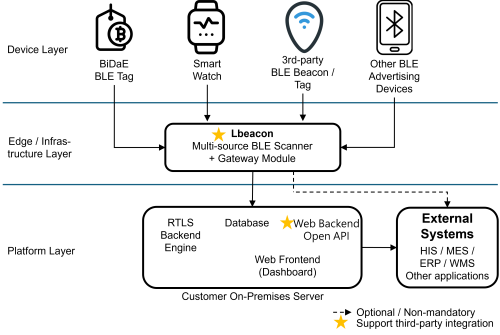
BiDaE Indoor Positioning System Platform is an open platform for indoor navigation and real-time indoor object tracking applications: It supports BiDaE’s own Seeing-I-Go mobile app and BiDaE Object Tracker. The platform can integrate with a wide range of Bluetooth broadcasting devices and provides RESTful APIs to support various web-based applications. This enables it to flexibly adapt to different usage scenarios and to be easily expanded or adjusted as requirements evolve.
The work done by BiDaE Indoor Positioning System Platform is carried out collaboratively by two types of components: tags and location beacons (Lbeacons). Together, they form a fog of Internet of Things (IoT).
Tags are Bluetooth Low Energy (BLE) transmitters. Every tag has a universally unique identifier (UUID). It broadcasts continuously advertizing packets containing its UUID and thus makes its presence known to Bluetooth receivers near by. Object tracking systems use of this feature to make objects to be located and tracked visible to the system: This is done by attaching to (or wearing by) every object to be visible to the system a tag and storing in the server an association of the tag UUID with the object ID/name. Thus, the location of each visible object is given by the location of the associated tag.
There are two types of tags: simple tags and sensor tags. Simple tags do nothing but broadcasting their UUID’s. Sensor tag contains sensors. In addition to its UUID, each sensor tag also broadcasts readings of its sensor(s) periodically. Smart watches are examples. Each watch reads and broadcasts regularly vital signs of the person wearing it. Some sensor tags can provide acceleration readings. A real-time object tracker can use them to support remote vital sign and movement monitors.
Lbeacons are a BLE transceivers. They are powered by AC or PoE (power over Ethernet) and are connected to the BiDaE Indoor Positioning System Platform server via WiFi or Ethernet. In a building served by a BiDaE Indoor Positioning System Platform, they are installed throughout the area covered by the system.
Each Lbeacon broadcasts continuously its own 3D coordinates or UUID via a directional antenna to devices in its coverage area of a few meters in radius. Thus, it provides navigation apps on the devices with position data. Each Lbeacon also scans its coverage area continuously. When it hears a tag, it sends to the server the tag’s UUID, its own UUID, and the time interval during which the tag is heard. Based on data from all Lbeacons, the server determines the location of every tag at all times. Every Lbeacon also forwards to the server time stamped sensor readings from every sensor tag. Thus, BiDaE Indoor Positioning System Platform effectively functions as a sensor data crowdsourcing system.
The vertical location of every tag reported by BiDaE Indoor Positioning System Platform is in terms of the floor level on which the tag is. This data is always accurate. The system can be configured to achieve a wide range of horizontal location accuracy by making use of more or fewer Lbeacons. In order to bring the user to within sight of sought-after objects, Lbeacons need to be configured to achieve than 3-5 meters or 5-10 meters horizontal accuracy. This is often referred to as bed/desk-level or room-level accuracy, respectively. In hospitals and other healthcare facilities, this configuration is typically used for areas such as emergency department and patient wards. Often, zone-level (i.e., 10-20+ meter) or floor-level accuracy in all or some areas suffices. This setting is usually used when the goal is to determine whether the sought-after object is in the building, or on which floor, in which patient ward or which part of a ward.
The list below summarizes the distinct merits of the BiDaE Indoor Positioning System Platform: You can find further details on the system from the white paper titled BiDaE indoor Positioning System at a Glance. You are also welcome to Schedule a Chat.
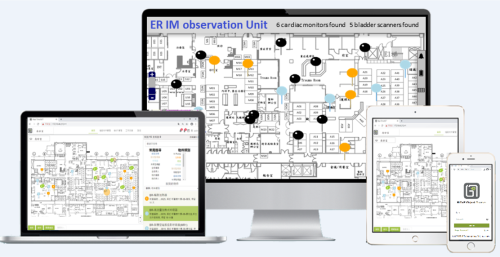
BiDaE Object Tracker(Total RTLS Solution) is a system of software tools for use within hospitals, elderly care facilities, office buildings, factories, etc. Its primary function is to help you locate objects, i.e., devices, equipment, people, etc. BiDaE Object Tracker also has tools to support your decisions and streamline your work processes and tools to help your organization prevent theft, follow best practices in device/equipment management, control building access, ensure safety of people, and so on.
You can think of BiDaE Object Tracker as an intelligent database on the platform BiDaE indoor Positioning System Platform(BPS) deployed in the space covered by the BiDaE Object Tracker. You access the data and tools provided by it via its browser-based graphical user interface (GUI). The data stored in the database are collected collaboratively by Bluetooth tags and Lbeacons (Location beacon). They are components of BiDaE Indoor Positioning System Platform.
Tags are battery powered transmitters. Each tag has a UUID (Universally Unique ID) and continuously broadcasts the UUID. When in use by BiDaE Object Tracker, it is attached to, or worn by, an object to be located and tracked. The system maintains an association of the tag UUID and the name/ID of the object. By doing so, the location of the object is given the location of the associated tag.
Lbeacons are transceivers powered by AC or Power over Ethernet and are connected via WiFi or Ethernet to the BiDaE Indoor Positioning System Platform server. Each Lbeacon is located at a location known to the server and has a coverage area a few meters in radius. It continuously scans the area. When it hears a tag, it sends to the server the tag’s UUID, its own UUID and the time interval during which the tag is heard. Based on data from all Lbeacons, the server determines the locations of all tags/objects at all time and store the data in the database.
Clearly, BiDaE Object Tracker inherits the advantages of BiDaE Indoor Positioning System Platform: Depending on users’ needs, it can be configured to provide 3-5 m, 5-10 m, and 10- 20+ m location accuracy. It can response in timely fashion to hundreds of concurrent searches for thousands of objects. It is robust, scalable and easy to deploy, customize and maintain. Finally, it is available for 99.95 % of the time.
In addition to advantages inherited from the underlying BiDaE Indoor Positioning System Platform, BiDaE Object Tracker has the following distinct features:
Core capabilities provided by every BiDaE Object Tracker include the following:
The system provides many advanced and custom functions. They are included in your BiDaE Object Tracker upon request by your organization.
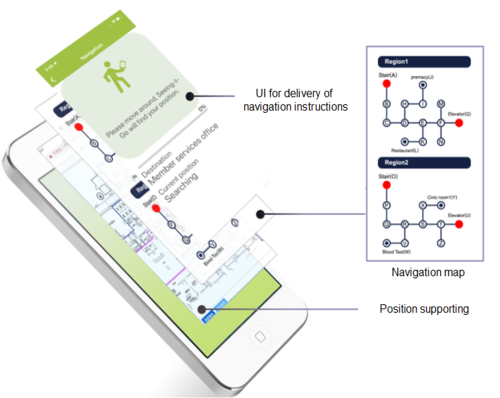
Seeing-I-Go is the mobile Bluetooth navigation app offered by BiDaE. You can use it to guide you in building complexes indoors and outdoor spaces around buildings. Its user interface is simple and easy to use and does not require you to look at the screen for long and frequently. Its distinct features include
